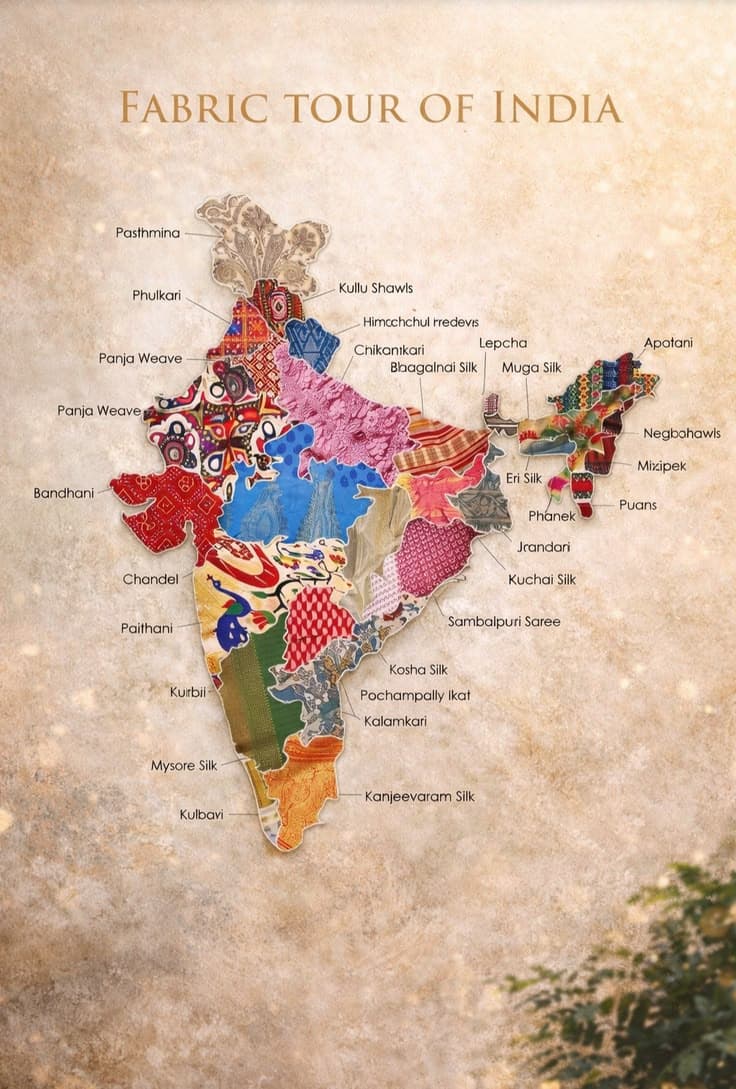
No country in the world has a textile culture as rich, as diverse, or as deeply embedded in daily life as India. Every state, every region, often every district has its own weaving or embroidery tradition — a distinct visual language that evolved over centuries in response to local raw materials, climate, cultural practices, and trade connections. Understanding Indian textiles is understanding India itself.
"In India, a saree is not just clothing. It is biography — region, religion, season, and ceremony all woven into six yards of fabric.
01The Ancient Roots: Cotton and the Indus Valley
Archaeological evidence from the Indus Valley Civilisation (roughly 3000–1500 BCE) confirms that cotton cultivation and textile production were already well developed in the Indian subcontinent thousands of years ago. Greek and Roman texts describe Indian cotton as among the finest trade goods of the ancient world — the famous 'woven air' muslin of Dhaka was so fine that it was described as 'running water' when draped.
This sophisticated understanding of fibre, spinning, and weaving created a foundation that later generations would build upon with extraordinary creativity.
02Silk: Royal Fabric of South India
Kanjivaram (or Kanchipuram) silk sarees from Tamil Nadu represent one of India's greatest textile achievements. Woven on handlooms from pure mulberry silk with a zari (gold or silver thread) border, a traditional Kanjivaram can take five to seven days to complete and represents a significant investment — both financially and culturally.
The characteristic features of authentic Kanjivaram — the thick, lustrous body that 'stands up' when draped, the contrasting border woven separately and then joined to the body — are the result of techniques passed down within weaving families for generations. Chennai's Kanchipuram district remains the primary production centre today.
03Regional Embroidery: India's Textile Map
Across India's regions, embroidery traditions developed in parallel with weaving traditions — each creating its own visual identity. Phulkari from Punjab celebrates the harvest with dense, brilliantly coloured geometric stitching worked on handspun cotton. Kantha from Bengal is meditative and narrative — rows of running stitch creating pictures that tell stories from mythology and daily life.
Banjara embroidery from the nomadic communities of central India uses mirror work, bold colours, and dense geometric patterns that reflect a landscape and a way of life. Chikankari from Lucknow is all delicacy — white thread on white cloth creating patterns so fine they are visible only in raking light.
04The Modern Challenge: Keeping Handcraft Alive
India's handloom and handicraft sector employs tens of millions of people, making it the second-largest employment sector in the country after agriculture. Yet it faces severe pressure — from power-loom imitations, from fast fashion, from the migration of rural artisans to urban industrial jobs.
The response from premium consumers and the fashion industry has been encouraging. The 'handloom mark' and 'GI tag' systems protect authentic regional products. Indian fashion designers increasingly champion handcraft credentials as a mark of distinction. And institutions like Vajra Aari Academy ensure that the next generation of artisans has both the technical skills and the business literacy to build sustainable careers.
From the Academy
India's textile heritage is not a museum exhibit. It is alive in every market, every workshop, every home where someone sits at a loom or picks up a needle. Supporting handcraft is supporting living culture — and wearing it is carrying that culture forward.